Imagine spending weeks building backlinks, watching your backlink count grow, and expecting your Google rankings to climb—only to see your competitors outrank you with fewer links. What are they doing differently?
The answer lies in backlink quality, not just quantity.
Understand this: A backlink’s value depends on where it comes from, how naturally it fits the content, and why it exists in the first place.
As a matter of fact, back in 2012, Google’s Penguin update targeted webspam associated with manipulative link-building practices. More than a decade later, the broader lesson remains relevant: accumulating backlinks without considering their relevance, credibility, and acquisition methods is not a reliable way to improve search rankings.
Simply put, more backlinks don’t necessarily mean better rankings.
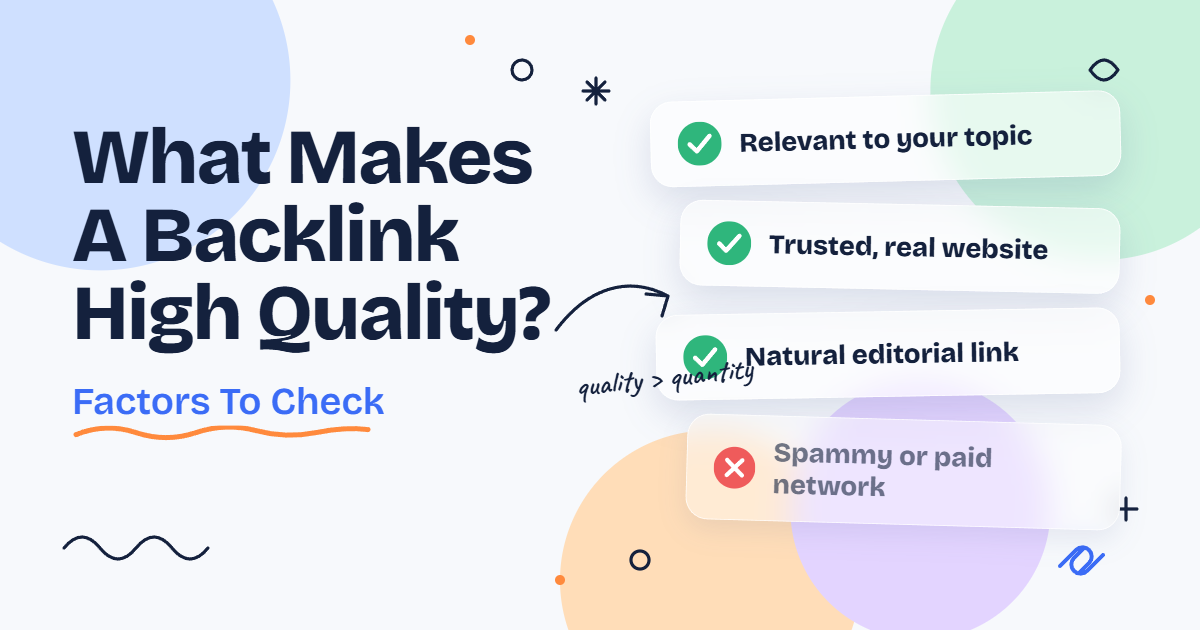
So, what separates a high-quality backlink from an ordinary one? Look beyond surface-level metrics. Assess the referring website’s relevance, the credibility of its content, the link’s placement, and the intent behind its acquisition. These signals provide a more meaningful picture of a backlink’s potential value.
In this guide, we’ll explore these factors in detail. You’ll learn how to assess link opportunities, spot potential red flags, and make smarter link-building decisions without relying on SEO metrics alone.
1. Relevance of the Linking Website
Imagine you run an SEO agency, and another website links to your guide on backlink quality. Before checking its Domain Rating (DR), ask yourself: Does this website have a genuine reason to link to your content?
This is where Topical relevance becomes an important factor in evaluating backlink quality. A backlink is more contextually relevant when the linking website and the specific page cover subjects related to your content, and the link fits naturally into the discussion.
Continuing the above example, a link to your backlink quality guide from an SEO publication discussing link-building strategies makes sense because the topics are closely related. A link from an unrelated website may provide less contextual value, even if that website has impressive SEO metrics.
How to check it in practice:
- Check the website’s content: Does it regularly publish useful information related to your industry?
- Examine the linking page: Is your content relevant to the specific subject being discussed?
- Read the surrounding paragraph: Does your link provide additional value to readers, or does it look inserted just to gain an SEO benefit?
Relevance should be evaluated at both the website and page levels. A website may cover multiple subjects, so don’t assume that every page on an otherwise relevant domain will offer the same value.
| Does a high Domain Rating guarantee a quality backlink?No. Domain Rating (DR) is Ahrefs’ third-party metric for measuring the strength of a website’s backlink profile. It is not a Google ranking score, and a high DR alone doesn’t prove that a backlink is valuable.A website might have a high DR but publish irrelevant content or place links in articles purely to sell them. Meanwhile, a smaller industry publication could offer a relevant, editorially placed backlink that makes more sense for your audience. Suppose you’re evaluating two websites for a backlink to your guide on backlink quality. Evaluation factorWebsite AWebsite BWebsite topicSEO and digital marketingGeneral entertainmentLinking pageArticle about link-building strategies Unrelated celebrity newsLink contextNaturally supports the discussion Little connection to your contentInitial assessmentStrong topical relevance Weak topical relevance In this example, Website A is the more relevant backlink opportunity based on the information available. However, you should still assess its credibility, editorial standards, link acquisition method, and the quality of the specific page before making a decision. |
Practical tip: Before pursuing a backlink, review the actual website, linking page, and surrounding content—not just its DR, Domain Authority (DA), or traffic figures. Ask yourself whether the link would genuinely help a reader. If it does, that’s a positive sign of relevance, although it doesn’t guarantee ranking benefits.
Practical Example: Evaluating Two Referring Websites
Suppose you’re evaluating two websites that could link to your backlink quality guide.
| Evaluation factor | Website A | Website B |
| DR score | 78 | 42 |
| Industry reputation | Unclear | Established niche publication |
| Content quality | Mostly promotional articles | Useful, relevant editorial content |
| Linking context | Paid placement with unclear editorial value | Natural reference in a relevant article |
| Initial assessment | Requires careful review | Potentially stronger opportunity |
These are illustrative examples, not real website audit results. Although Website A has a higher DR, Website B may be the more promising opportunity based on the available information. You would still need to verify both websites’ credibility, linking pages, and acquisition methods before making a decision.
Practical Tip
Use DR and DA as supporting comparison metrics, not as your primary decision criteria. Prioritize credible publishers, useful content, genuine industry recognition, and legitimate link acquisition methods.
A strong third-party authority score can help you shortlist websites, but it cannot establish backlink quality on its own. Evaluate the actual website and linking page before deciding whether a backlink is worth pursuing.
2. Authority of the Referring Website
Would you trust a recommendation from a well-known expert more than one from a website nobody has heard of? A similar idea applies to backlinks. The credibility of the website linking to your content is an important factor when evaluating backlink quality.
Referring website authority is about how established and credible a website is within its industry. You can assess it by looking at the quality of its backlink profile, the usefulness of its content, its reputation, and whether other trustworthy websites reference it.
In SEO, you may also hear the term link juice. It refers informally to the ranking value a link may pass to another page. A link from a credible, established website can be a valuable SEO opportunity, but its impact isn’t determined by authority alone. Relevance, the quality of the linking page, and how naturally the link was earned also matter.
For example, if your article explains what makes a backlink high quality, a link from an established SEO publication that references your guide in a relevant article could be a worthwhile opportunity. The publication’s reputation may help readers trust the recommendation, while the contextual link gives them a useful resource to explore.
How to Evaluate a Website’s Authority
Before pursuing a backlink, check whether the website:
- Has a credible backlink profile: Its links come from genuine, relevant sources rather than obvious link schemes.
- Publishes useful content: Its articles offer real value instead of existing mainly to sell backlinks.
- Has an established industry presence: Other relevant websites, professionals, or publications reference its work.
- Maintains editorial standards: Content and outbound links are relevant and selected for readers, not simply published in exchange for payment.
You can use Ahrefs’ Domain Rating (DR) or Moz’s Domain Authority (DA) as supporting comparison metrics, but neither is an official Google ranking score.
What about dofollow backlinks? Standard links without a qualifying rel attribute can be used by Google as ranking signals. SEO professionals often call these dofollow links and use link juice to describe the potential ranking value they pass. However, rel=”dofollow” is not required, and no link attribute guarantees a ranking improvement.
Practical takeaway: Look for a referring website that has earned credibility through useful content, genuine industry recognition, and a trustworthy backlink profile. A high authority score alone is not enough to establish backlink quality.
| Are High DR and DA Websites Always Better?No. Ahrefs’ Domain Rating (DR) and Moz’s Domain Authority (DA) are third-party metrics that help compare websites. They are not official Google ranking scores, and neither guarantees that a particular backlink will improve your rankings.For example, a website with a high DR may have a large backlink profile but publish content unrelated to your industry. Another website with a lower DR may be a respected specialist publication with an audience that genuinely benefits from your content.In this situation, the second website may be a more relevant opportunity, depending on its credibility, editorial context, and how the link is acquired. The objective isn’t to choose the website with the lowest or highest score, but to evaluate the complete opportunity. |
3. Relevant and Natural Anchor Text
Have you ever clicked a link expecting one thing but landed on a page about something completely different? That’s what irrelevant anchor text can do to readers. It creates confusion and makes a backlink feel unnatural.
Anchor text is the clickable text of a hyperlink. Suppose, another website links to your article using the words what makes a backlink high quality, those words are the anchor text. Relevant anchor text helps readers understand what to expect from the linked page and provides context about the link.
Google recommends using anchor text that is descriptive, reasonably concise, and relevant to both the page containing the link and the destination page. You can learn more in Google’s official guide to link best practices and descriptive anchor text.
For SEO, the goal is to use anchor text that accurately describes the destination without forcing keywords into every link. Google considers links and their surrounding context when understanding pages, but there is no single anchor-text formula that guarantees better rankings.
What does natural anchor text look like?
- Descriptive: Clearly explains what the linked page covers.
- Relevant: Matches the topic of the destination page and the surrounding content.
- Natural: Fits smoothly into the sentence instead of sounding written purely for SEO.
- Varied: Across backlinks, anchor text can naturally include brand names, page titles, URLs, and descriptive phrases.
For example, if a marketing blog discusses link-building strategies, it could naturally link to your guide with the anchor text backlink quality factors. That tells readers what they’ll find after clicking. However, if dozens of websites use the exact same keyword-rich anchor text because you instructed them to, the pattern may look manipulative.
Practical tip: When earning backlinks, focus on the context and usefulness of the link rather than trying to control every anchor text. Avoid excessive exact-match keywords, misleading phrases such as “click here” when more descriptive wording would help, and links inserted only to manipulate rankings. Natural, relevant anchor text improves clarity for readers, while no particular anchor text guarantees a ranking boost.
| Examples of Good and Poor Anchor TextAnchor textAssessmentWhyLink2GrowthPotentially naturalIdentifies the brandbacklink quality factorsDescriptiveExplains the destination topichttps://example.com/guideSometimes appropriateUses a visible URLClick hereGenericProvides little context on its ownbest high-quality backlinks SEO link-building serviceOver-optimizedCramming keywords together can look unnaturalThese examples are illustrative. Whether an anchor is appropriate depends on the surrounding sentence, destination page, and reason the link exists. |
4. Natural and Contextual Link Placement
A backlink can come from a relevant, authoritative website and still be a weak opportunity if it’s placed where it makes little sense. Where and how a link appears within a page matters because it affects its context, usefulness, and visibility to readers.
Natural link placement means a website links to your content because it adds useful information to the discussion—not simply because someone wants to build backlinks. A contextual link appears within the main body of relevant content, where readers can understand why the linked resource is worth visiting.
For example, if a digital marketing article explains how to evaluate referring domains, linking naturally to your guide on what makes a backlink high quality can help readers explore the topic in more detail. The link supports the discussion instead of interrupting it.
What Makes Link Placement Natural?
- Fits the surrounding content: The link relates directly to the paragraph and the topic being discussed.
- Provides value to readers: The destination offers additional information, evidence, or a useful resource.
- Appears in a meaningful context: Readers can understand why the website is linking to that particular page.
- Isn’t placed solely for SEO: The link doesn’t look forced into an unrelated article just to influence rankings.
Links placed within relevant editorial content can be useful backlink opportunities. However, being inside the main article doesn’t automatically make a backlink high quality. A contextual link can still be manipulative if it was placed as part of a link scheme.
| Contextual Links vs. Manipulative Link PlacementsConsider two websites that offer links within their articles.Website A references your guide because it provides useful information that supports the article’s discussion. Website B inserts a link into an unrelated guest post primarily to influence search rankings.Although both links might appear inside the main content, their purpose and context are different. Website A presents a more natural editorial opportunity, while Website B raises concerns about the reason the link was created.Google’s spam policies for web search identify link schemes intended to manipulate rankings as a violation. These can include paid links that pass ranking credit, excessive link exchanges, and automated link creation. Paid placements used for advertising or sponsorship should be appropriately qualified, such as with rel=”sponsored” or rel=”nofollow”, where applicable. |
Practical tip: Always review the actual page where your link may appear. Read the surrounding paragraph, assess the usefulness of the destination, and understand why the publisher would include the link. Prioritize relevant editorial placements that benefit readers, and avoid opportunities created primarily to manipulate search rankings.
Natural placement is an important consideration when evaluating backlink quality, but it does not guarantee ranking improvements. Always assess the referring website’s credibility, topical relevance, and link acquisition method alongside placement.
5. Potential to Bring Relevant Referral Traffic
What if a backlink doesn’t just support your SEO efforts but also brings people who are genuinely interested in your content? That’s another sign of a worthwhile backlink opportunity.
Referral traffic is the traffic your website receives when visitors click links on other websites to reach your pages. A relevant backlink can introduce your content to an audience that already has an interest in your topic. Even if the link doesn’t bring hundreds of visitors, a few genuinely interested readers may be more valuable than a large number of irrelevant clicks.
For example, if an SEO publication links to your guide on what makes a backlink high quality, readers researching link-building strategies may click through to learn more. These visitors are more likely to find your content relevant because the link appears on a website related to their interests.
How to Evaluate a Backlink’s Referral Traffic Potential
- Audience relevance: Does the linking website attract people who may genuinely benefit from your content?
- Page visibility: Does the specific page receive visitors, or is it an outdated article that rarely gets read?
- Link visibility: Is the link placed naturally where readers can notice and use it?
- Content alignment: Does your linked page provide the information readers are likely to need next?
You can use Google Analytics 4 (GA4) to track referral visits under Reports → Acquisition → Traffic acquisition. Look for traffic where the session source or medium identifies the referring website. You can also review engagement and conversions to understand whether those visitors find your content useful.
Practical tip: Don’t judge a backlink opportunity by the referring website’s total traffic alone. A site may attract thousands of visitors, but if its audience isn’t interested in your topic, the link may send little relevant traffic. Focus on audience fit, the visibility of the linking page, and whether the link gives readers a genuine reason to visit your website.
Remember, referral traffic potential is one way to evaluate a backlink—not a guarantee of SEO improvement. A link can still be useful for discovery and relevant visitors even when it sends only a small amount of traffic.
| How to Track Referral Traffic in Google Analytics 4Google Analytics 4 (GA4) can help you understand whether visitors are reaching your website through links on other websites and what they do after arriving.To review referral traffic:Sign in to your Google Analytics 4 property.Open Reports → Acquisition → Traffic acquisition.Review the traffic source information, particularly Session source / medium.Look for referring domains and traffic identified with the referral medium.Review relevant metrics, such as sessions, engaged sessions, and key events, to understand whether visitors interact with your content or complete valuable actions.You can also filter the report by landing page to examine traffic reaching a particular article or service page. The exact report layout may vary depending on your GA4 configuration.For more details, see Google’s official guide to the GA4 Traffic acquisition report. The report helps you understand where sessions originate and how visitors engage with your website. |
6. Brand Credibility and Visibility in AI Search
A backlink can do more than support traditional SEO—it can also help people discover your brand through relevant online content. As users increasingly turn to AI-powered search tools for answers, building a credible online presence across trusted websites can support brand discovery.
AI search visibility refers to how often your website or brand appears in AI-generated answers on platforms such as ChatGPT, Google AI Overviews, and Perplexity. Brand mentions occur when other websites discuss your business, even when they don’t include a clickable link.
For example, if a respected digital marketing publication mentions your brand while discussing link-building services, readers may discover your business through that article. Depending on the content and sources used, such mentions may also help AI systems identify information about your brand. However, a mention or backlink does not guarantee inclusion in AI-generated answers.
For more details, see Google’s official guidance on AI features and your website. Google explains that established SEO best practices remain relevant to AI search features and that there are no special optimizations that guarantee inclusion in AI-generated search results.
How to improve AI search visibility:
- Publish accurate, helpful content that demonstrates real expertise.
- Earn genuine mentions and links from relevant, trustworthy publications.
- Keep your brand name, services, and business information consistent online.
- Answer specific questions clearly so readers and search systems can understand your expertise.
For Google Search, use Google Search Console to monitor organic performance and any available AI-specific reporting. Google introduced a dedicated Generative AI performance report for tracking visibility within supported AI features in Search and Discover. You can read about it in the official Google Search Central announcement.
For ChatGPT and Perplexity, you can periodically test relevant questions and record whether your brand or pages appear. Treat these checks as observations rather than definitive measurements, because responses may vary by query, time, and context.
Practical tip: Don’t build backlinks solely to appear in AI answers. Focus on making your brand a credible source of useful information. Strong content, genuine industry recognition, and a consistent online presence can support discoverability across both traditional search and AI-powered search experiences.
How to Find High-Quality Backlinks for Your Website
Follow these steps to find relevant backlinks that can support your SEO efforts.
Step 1: Find Relevant Websites
Search for websites in your niche that publish useful, related content. Prioritize topical relevance over high DR or DA scores.
Step 2: Analyze Competitor Backlinks
Use Ahrefs or Semrush to find websites linking to your competitors. Identify relevant pages where your content could provide additional value.
Step 3: Check Website Quality
Review the website’s content, backlink profile, reputation, and outbound links. Avoid sites that exist mainly to sell backlinks.
Step 4: Create Link-Worthy Content
Publish useful guides, original research, case studies, and practical resources that other websites have a genuine reason to reference.
Step 5: Reach Out to Website Owners
Build relationships with relevant publishers, suggest useful resources, and offer valuable guest contributions where appropriate. Avoid link schemes designed to manipulate rankings.
Step 6: Monitor Your Backlinks
Use Google Search Console, Ahrefs, or Semrush to track new referring domains and review backlink quality. Use Google Analytics 4 to measure referral traffic.
Tip: Focus on relevant, trustworthy backlinks that benefit readers rather than chasing backlink quantity or authority scores alone.
Final Thoughts
Building backlinks isn’t about getting links from just any website. It’s about earning quality backlinks that follow the right SEO practices, come from relevant sources, and support your website’s long-term growth.
At Link2Growth, we focus on building high-quality backlinks by prioritizing website relevance, authority, natural link placement, and genuine value. We follow quality-focused link-building practices to help your website build a stronger backlink profile.
Looking for high-quality backlinks for your website? Explore backlink services at Link2Growth and let us help you strengthen your link-building strategy with a focus on quality, relevance, and sustainable SEO growth.
Frequently Asked Questions
1. How Many Backlinks Does a Website Need to Rank on Google?
There is no fixed number of backlinks required to rank on Google. It depends on your niche, competition, content quality, and the strength of competing pages. Focus on earning relevant backlinks rather than reaching a specific number.
2. Can a Website Rank on Google Without Backlinks?
Yes, a website can rank without backlinks, especially for less competitive keywords. However, relevant backlinks can help Google discover content and may contribute to ranking signals. Content quality, search intent, and technical SEO also matter.
3. How Can I Tell If a Backlink Is Worth Pursuing?
Check the website’s relevance, content quality, reputation, backlink profile, and the specific page where your link may appear. Don’t rely only on Domain Rating (DR), Domain Authority (DA), or estimated traffic.
4. Are Backlinks From Websites With Low Traffic Still Valuable?
Yes. A website with modest traffic can still be a valuable backlink source if it is credible, relevant to your niche, and has a genuine reason to reference your content. Low traffic alone doesn’t make a backlink low quality.
5. Can AI-Generated Content Earn High-Quality Backlinks?
Yes. AI-assisted content can earn backlinks if it provides accurate information, original insights, useful research, or genuine expertise. Content that simply rewrites existing articles without adding value is less likely to attract meaningful references.
6. How Long Does It Take for a Backlink to Affect Rankings?
There is no guaranteed timeline. Google needs to discover and process links, and ranking changes depend on multiple factors. Some backlinks may not produce noticeable ranking improvements, so monitor organic performance over time.
7. What Is the 80/20 Rule in SEO?
The 80/20 rule suggests that a small portion of your SEO efforts may generate most of your results. For example, a few successful content pages or backlink opportunities may contribute significantly to organic traffic. However, this is a general productivity principle, not a fixed Google ranking rule.
8. How Can I Build High-Quality Backlinks?
Build high-quality backlinks by publishing useful content, conducting original research, analyzing competitor backlinks, finding relevant broken-link opportunities, and building relationships with publishers. Avoid link schemes designed to manipulate search rankings.
9. How Much Does It Cost to Get a High-Quality Backlink?
The cost varies depending on the website, industry, outreach method, and link-building service. Some backlinks are earned through free outreach, while digital PR and content creation require a budget. Paying for links to manipulate rankings can violate Google’s spam policies, so evaluate services by their methods and quality standards.
10. Which Backlink Is the Most Powerful?
There is no single backlink type that is always the most powerful. A relevant, editorially earned link from a credible website can be valuable when it naturally supports the content. Its potential value depends on relevance, the linking page, and how the link was acquired. No backlink guarantees higher rankings.